
Kerala is one of the wettest states in India. It has rivers, ponds, reservoirs, wells and a long monsoon season. Yet, every summer, many parts of the state experience drinking-water shortages.
This apparent contradiction points to an important reality:
Kerala’s future drinking-water challenge may not simply be a shortage of water. It will
increasingly be a challenge of ensuring that safe water is available at the right place, in the right quantity, at the right quality and throughout the year.
The Kerala government’s own water-security initiatives recognise that the state’s water
availability is closely dependent on rainfall and that drinking-water planning needs to be
linked to local water availability and sustainable management.
From Water Availability to Water Security
Traditionally, Kerala depended heavily on open wells, ponds, springs and other decentralised sources. With urbanisation and changing lifestyles, dependence on piped water, bore wells and centralised supply systems has increased.
At the same time, demand for water is increasing in homes, institutions, hospitals, schools, commercial establishments and public spaces.
The challenge therefore is changing.
It is no longer enough to ask:
“Is water available?”
We increasingly have to ask:
“Is safe drinking water reliably available throughout the year?”
This distinction will become increasingly important during the coming decade.
1. Climate Variability Will Make Water Planning More Difficult
Kerala may receive heavy rainfall, but the timing, intensity and distribution of rainfall matter as much as the annual total.
Periods of intense rainfall can produce flooding and rapid runoff, while longer dry periods can create local water shortages.
Kerala State Disaster Management Authority is already providing climate-change projections to local governments for near-, medium- and long-term planning, including projected changes in precipitation and temperature.
This means future drinking-water infrastructure must be designed not merely on historical rainfall patterns but with climate resilience in mind.
Water conservation, groundwater recharge, rainwater harvesting and protection of local
sources will therefore need to become integral parts of drinking-water planning rather than separate environmental programmes.
2. Groundwater Cannot Be Taken for Granted
Wells have traditionally been one of Kerala’s greatest strengths.
But groundwater is not an unlimited resource.
The Central Ground Water Board continuously assesses groundwater recharge, extraction and the condition of assessment units, classifying areas according to the pressure placed on groundwater resources.
The concern is not simply how much groundwater is available.
Quality is equally important.
Depending upon location and geology, groundwater can be affected by iron, salinity and
other contaminants. Coastal regions also face additional vulnerability from saline-water
intrusion.
Therefore, a source that contains water cannot automatically be considered a source of
drinking water.
The future approach has to combine: source protection + water-quality testing + appropriate treatment + continuous monitoring.
3. Water Quality May Become a Bigger Problem Than Water Quantity
For community drinking-water projects, this may become one of Kerala’s most important challenges.
A Panchayat may have a bore well.
A municipality may have a public water source.
A school may have adequate water in its well.
But the real question is:
Is that water consistently safe for drinking?
Water quality can change seasonally. Heavy rainfall can introduce microbial contamination.
Summer conditions can concentrate certain dissolved substances. Source conditions can also change because of nearby development, sewage, agriculture or saline intrusion.
Therefore, testing water only while commissioning a project is not enough.
Community drinking-water systems of the future will need periodic water-quality
monitoring and treatment systems designed according to the actual characteristics of the
source.
4. Urbanisation Will Put Increasing Pressure on Local Water Sources
Kerala is experiencing a continuous transformation of rural areas into semi-urban
settlements.
More houses, apartments, commercial buildings, hospitals, tourism facilities and institutions create additional demand for water while simultaneously reducing natural groundwater recharge areas.
Concrete surfaces, roads and buildings prevent rainwater from slowly entering the soil.
The result can be paradoxical: more intense flooding during the monsoon and greater local water stress during summer.
This is why drinking-water planning can no longer be separated from land-use planning,
drainage, rainwater harvesting and groundwater recharge.
5. Public Places Need a Different Drinking-Water Strategy
Household tap connections are an essential part of water security. The Jal Jeevan Mission itself combines household water supply with measures such as source sustainability, rainwater harvesting, conservation and groundwater recharge.
But household connections do not solve every drinking-water requirement.
People also need safe drinking water while they are outside their homes:
at bus stands, markets, hospitals, government offices, schools, tourist destinations, railway and transport locations, playgrounds and other public spaces.
This creates an important role for community drinking-water infrastructure.
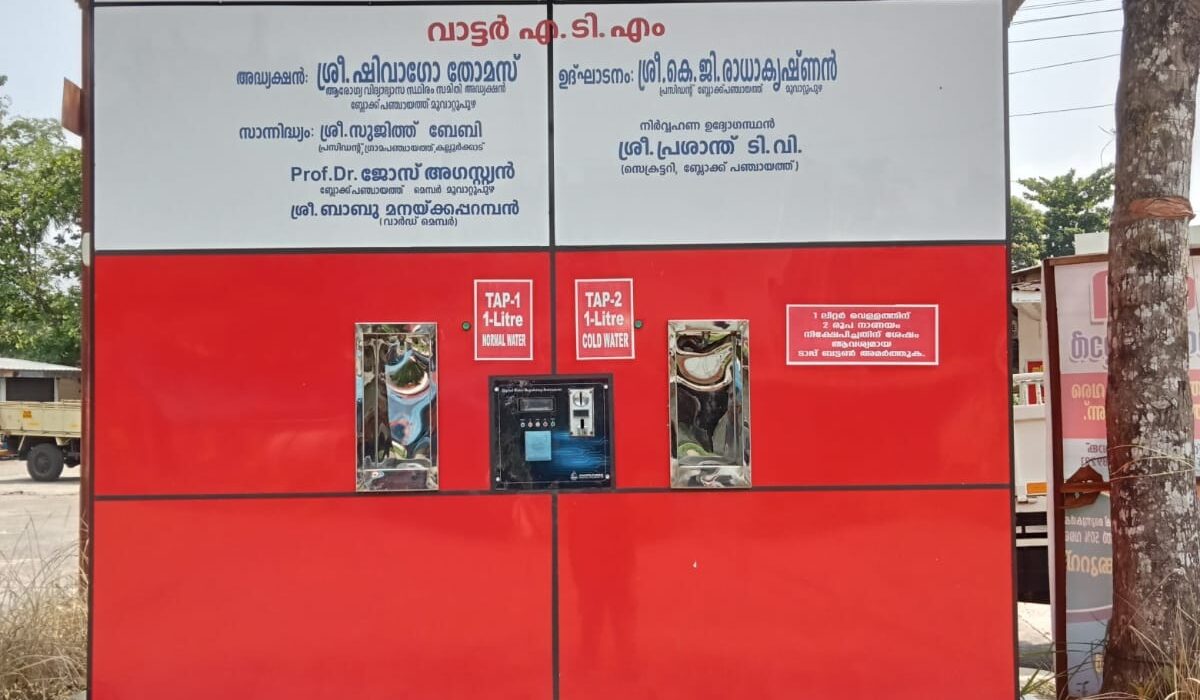
Instead of depending entirely on packaged drinking water, properly designed community water kiosks and dispensing systems can provide an economical and environmentally responsible source of treated drinking water.
6. Installing a Water Plant Is Only the Beginning
One of the biggest challenges Kerala will face is not the construction of new drinking-water projects.
It is their long-term operation and maintenance.
A sophisticated purification system will not serve the community if filters are not changed, membranes are neglected, pumps fail, storage tanks are unhygienic or water quality is never retested.
Future public projects therefore have to move away from an approach based simply on:
Purchase → Install → Inaugurate towards a lifecycle approach:
Survey → Design → Install → Monitor → Maintain → Test → Upgrade
The success of a community drinking-water project should ultimately be measured by how consistently it supplies safe water after three, five or even ten years—not merely by whether the equipment was successfully commissioned.
7. Technology Will Have a Larger Role
The next generation of community drinking-water systems can become significantly smarter.
Remote monitoring can help identify equipment failures. Digital flow meters can measure actual water utilisation. Sensors can monitor operating parameters. UPI-enabled dispensing can support controlled public distribution where required.
Automated alerts can help service teams respond before minor problems become major failures.
But technology alone is not the solution.
A successful system requires the correct combination of water-source assessment,
treatment technology, engineering, preventive maintenance and local accountability.
8. Local Governments Will Be at the Centre of Kerala’s Water Security
Kerala’s decentralised governance structure gives Panchayats, Municipalities and
Corporations an important role in solving community-level water problems.
One locality may have an iron problem.
Another may experience salinity.
Another may have sufficient water during the monsoon but severe shortages during
summer.
Another may need safe drinking-water access at a crowded public location rather than a new household distribution network.
Therefore, there cannot be one universal technical solution for every location.
The better approach is to develop local water-security plans based on source, demand,
quality and seasonal conditions.
Kerala’s Water Budget initiative similarly stresses the importance of integrating regional
water availability with the planning of drinking-water and agricultural schemes.
The Coming Decade: From Drinking-Water Projects to Water Security
Kerala’s future challenge is therefore larger than constructing more water-treatment plants.
The state needs to create resilient drinking-water systems.
That requires protecting water sources, improving recharge, continuously monitoring water quality, using appropriate treatment technologies, ensuring professional operation and maintenance, and creating convenient access to safe drinking water in community and public spaces.
Climate change makes this transition even more important. Kerala’s State Action Plan on Climate Change identifies water-resource resilience as an important area requiring
intervention.
Water World’s Perspective
At Water World, our experience with community drinking-water systems across Kerala hasreinforced one fundamental principle:
A drinking-water project is successful only when people can depend upon it every day.
The future of Kerala’s drinking-water infrastructure therefore lies not merely in nstalling more equipment, but in developing sustainable, locally appropriate and professionally maintained community water systems.
Kerala has the natural resources and technological capacity to achieve this.
The challenge for the coming years is to manage those resources intelligently—so that safedrinking water remains accessible to every community, in every season.